
Best Portable Power Stations for Emergency Use
Table of Contents
- How We Evaluated These Portable Power Stations
- Quick Comparison: Portable Power Stations for Emergency Use
- How to Calculate Power Needs for Emergency Outages
-
Top Picks: Best Units by Use Case
- Best for Whole-Home Backup: EcoFlow DELTA Pro
- Best Expandable Option: BLUETTI AC200MAX
- Best for Multiple Appliances: Anker PowerHouse 767
- Best Mid-Range Pick: Goal Zero Yeti 1500X
- Best Budget LiFePO4 Option: Renogy Phoenix 1000
- Best for Short Outages and RV Use: Generark HomePower 2
- Best Compact Option: Rockpals 300W
- Key Features to Look for in Emergency Backup Units
- Portable Power Station Battery Life Expectancy
- How to Store Portable Power Stations Safely Long-Term
- Conclusion
Last Updated: August 23, 2026
Grid-down situations expose exactly how unprepared most households are. A refrigerator full of food, a CPAP machine, a sump pump, a router, none of them run on good intentions. Portable power stations have become serious household infrastructure, not just camping accessories. At The Modern Merchant Hub, we carry portable energy solutions because we know how quickly a power outage shifts from inconvenience to crisis.
This guide breaks down the best portable power stations across every budget and use case, with real runtime math, honest trade-offs, and the technical details that matter when the lights go out.
Quick Picks:
- Best for Whole-Home Backup: EcoFlow DELTA Pro, highest capacity and true home integration
- Best Expandable Option: BLUETTI AC200MAX, LiFePO4 chemistry with room to grow
- Best for Multiple Appliances: Anker PowerHouse 767, 2400W continuous output with UPS switching
- Best Mid-Range Pick: Goal Zero Yeti 1500X, solid build, established support
- Best Budget LiFePO4: Renogy Phoenix 1000, long cycle life at a lower price point
- Best for Short Outages and RV Use: Generark HomePower 2, high output, wheeled design
- Best Compact Option: Rockpals 300W, lightweight, pure sine wave, genuinely portable
How We Evaluated These Portable Power Stations
Emergency preparedness demands that a unit deliver its rated capacity under load, handle real household appliances, and survive years of infrequent use without degrading. Our evaluation focused on five factors: battery chemistry and cycle life, continuous AC output and surge capacity, charging flexibility, portability relative to capacity, and safety features including battery management systems.
We prioritized pure sine wave inverters across all picks. Modified sine wave output can damage sensitive electronics, motor-driven appliances, and medical devices. For genuine emergency backup, only pure sine wave output is acceptable.
Quick Comparison: Portable Power Stations for Emergency Use
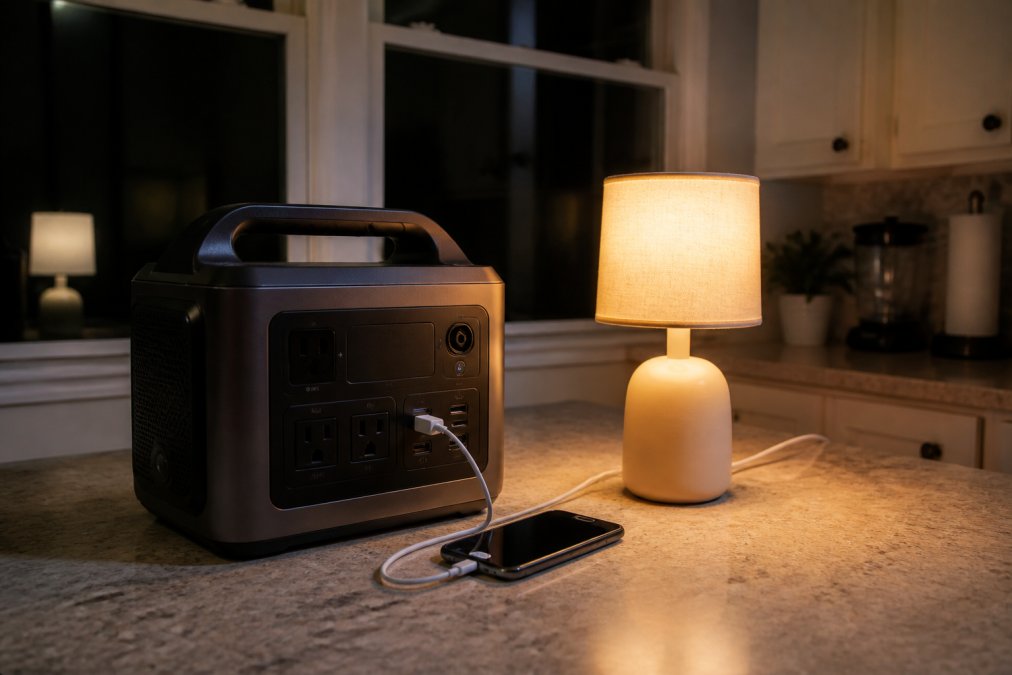
| Model | Capacity | AC Output | Battery Type | Best For | Starting Price |
|---|---|---|---|---|---|
| EcoFlow DELTA Pro | 3600Wh (expandable) | 3600W | LiFePO4 | Whole-home backup | $1,899 |
| BLUETTI AC200MAX | 2048Wh (expandable to 8192Wh) | 2200W | LiFePO4 | Extended outages, expandability | $1,199 |
| Anker PowerHouse 767 | 2048Wh (expandable to 4096Wh) | 2400W | LiFePO4 | Multiple appliances, UPS | $1,999 |
| Goal Zero Yeti 1500X | 1516Wh | 2000W | Lithium-ion | Mid-range backup | $1,124 |
| Renogy Phoenix 1000 | 998Wh (expandable to 1997Wh) | 1500W | LiFePO4 | Budget LiFePO4 | $649 |
| Generark HomePower 2 | 2060Wh | 2200-4400W | Lithium-ion | RV, short outages | $999 |
| Rockpals 300W | 280Wh | 300W | Lithium-ion | Small electronics, CPAP | $285 |
How to Calculate Power Needs for Emergency Outages
Most people buy a portable power station that is either wildly undersized or more than they will ever need. A ten-minute calculation before purchase solves this.
List every appliance you need to run during an outage and find its wattage on the label. Multiply running watts by hours of daily use. Add those figures together for your daily watt-hour requirement. A portable power station's usable capacity is typically 80-90% of its rated watt-hours, accounting for inverter losses and battery management limits.
Running Watts vs. Surge Watts: What the Numbers Mean
Running watts are the continuous power draw during normal operation. Surge watts (peak power) are the brief spike when a motor-driven appliance starts, a refrigerator compressor, sump pump, or air conditioner. This surge typically lasts under a second but can be two to three times the running watt rating.
Your portable power station's surge capacity must exceed the highest surge demand of any single appliance. A unit with 2000W continuous output but only 3000W surge will fail to start a refrigerator with a 2200W starting surge, even if the fridge only draws 150W while running.
Real-World Runtime Examples for Common Appliances
These estimates assume a 2048Wh unit with 85% usable capacity (approximately 1740Wh practical output):
| Appliance | Running Watts | Estimated Runtime |
|---|---|---|
| Refrigerator (modern, efficient) | ~150W average | ~11 hours |
| CPAP machine (no heat) | ~30-60W | ~29-58 hours |
| LED lights (10 bulbs) | ~100W | ~17 hours |
| Laptop | ~45W | ~38 hours |
| Box fan | ~50W | ~34 hours |
| Sump pump | ~400W running | ~4 hours |
| Window AC (5,000 BTU) | ~500W | ~3.5 hours |
Running multiple appliances simultaneously reduces these runtimes proportionally. A refrigerator plus four LED lights plus a CPAP machine draws roughly 300W combined, giving you approximately 5-6 hours of runtime from that same 2048Wh unit.
Top Picks: Best Units by Use Case
Best for Whole-Home Backup: EcoFlow DELTA Pro
The EcoFlow DELTA Pro is the most capable portable power station for whole-home emergency backup. At 3600Wh base capacity, expandable up to 90kWh with additional expansion batteries, it can meaningfully cover high-demand appliances like central air conditioning or electric ranges. The 3600W continuous AC output and 7200W surge capacity handle virtually any household appliance. Critically, the DELTA Pro integrates directly into a home's electrical system via a transfer switch, enabling whole-home circuit backup without running extension cords through the house.
EcoFlow DELTA Pro product page
Pros:
- Exceptional 3600Wh base capacity with massive expandability
- 7200W surge capacity handles large motor-driven appliances
- Home electrical system integration via transfer switch
- Clean, silent operation, no fumes, no fuel
Cons:
- 121 lbs shipping weight makes repositioning a two-person job
- High price point represents significant investment
Best Expandable Option: BLUETTI AC200MAX
The BLUETTI AC200MAX starts at 2048Wh but expands to 8192Wh by adding external battery packs. That expandability, combined with LiFePO4 chemistry rated for 3500+ charge cycles to 80% capacity, makes it ideal for anyone who wants to grow their emergency backup system over time. The 2200W pure sine wave inverter with 4800W surge handles refrigerators, power tools, and most household appliances. Sixteen output ports let you run and charge multiple devices simultaneously.
Pros:
- LiFePO4 battery with 3500+ cycles, long-term reliability
- Expandable to 8192Wh for multi-day whole-home coverage
- 16 output ports cover virtually every device type
Cons:
- Noisy during heavy load operation
- 62 lbs limits single-person portability
Best for Multiple Appliances: Anker PowerHouse 767
The Anker PowerHouse 767 delivers 2400W continuous and 3600W surge from a 2048Wh LiFePO4 battery, more running power than competitors at comparable capacity. The 20ms UPS switching speed is decisive: when grid power drops, the PowerHouse 767 switches to battery in 20 milliseconds, fast enough to keep computers, routers, and sensitive electronics running without interruption. The telescopic handle and built-in wheels address the portability problem that plagues high-capacity units.
Pros:
- 2400W continuous output, highest in this list at the 2048Wh capacity tier
- 20ms UPS switching protects computers and sensitive electronics
- Built-in wheels and handle for easier movement
Cons:
- Cannot charge via AC and solar at the same time
- Heavy; stairs are a genuine obstacle
Best Mid-Range Pick: Goal Zero Yeti 1500X
The Goal Zero Yeti 1500X serves buyers who want a reputable brand, solid build quality, and US-based customer support. At 1516Wh with 2000W continuous and 3500W surge output, it covers most mid-range emergency scenarios: keeping a refrigerator running, charging phones and laptops, powering lights. The aluminum-bodied shell reflects build quality that holds up over years of storage.
Pros:
- Solid aluminum construction with durable port layout
- Two-year warranty and US-based customer support
- Compatible with Goal Zero's solar panel ecosystem
Cons:
- Lower real-world efficiency than rated capacity suggests
- Slow recharge time compared to competitors
Best Budget LiFePO4 Option: Renogy Phoenix 1000
LiFePO4 battery chemistry at under $700 is rare, and the Renogy Phoenix 1000 delivers it. At 998Wh with 1500W output and an iBoost mode that pushes peak power to 3000W, it handles more than its capacity tier suggests. The LiFePO4 cells are rated for 3000+ cycles. At 41 lbs, it is lighter than larger units while providing meaningful emergency backup for essential appliances: a refrigerator for short periods, a CPAP machine, lights, phone charging.
Renogy Phoenix 1000 product page
Pros:
- LiFePO4 chemistry with 3000+ cycle life at a budget price point
- iBoost mode extends peak power to 3000W
- Lighter than comparable-capacity units at 41 lbs
Cons:
- Parallel expansion kit sold separately
- 998Wh capacity limits multi-appliance runtime
Best for Short Outages and RV Use: Generark HomePower 2
The Generark HomePower 2 Plus delivers 2060Wh capacity with 2200-4400W AC output and a wheeled design that makes it easy to move through a house. At $999, it offers strong value for the capacity tier. The practical limitation: it lacks a built-in UPS system, which affects battery longevity during continuous pass-through charging over extended periods. For short outages of 12-24 hours, this is not a concern.
Pros:
- 2060Wh capacity with high AC output at competitive price
- Wheeled design for easy indoor repositioning
- Solar charging compatible for extended outage scenarios
Cons:
- No built-in UPS, limits suitability for sensitive electronics
- Heavier units may require two people for stairs
Best Compact Option: Rockpals 300W
The Rockpals 300W is not a home backup solution. At 280Wh and 300W output with 600W surge capacity, it cannot run a refrigerator or sump pump. What it does exceptionally well is keep small electronics running: phones, tablets, laptops, LED lights, and CPAP machines drawing under 96W. At 7.3 lbs with a pure sine wave inverter, it protects sensitive devices. For apartment dwellers, renters, or anyone who needs a lightweight unit for quick evacuation, the Rockpals 300W is the practical choice.
Pros:
- 7.3 lbs, genuinely portable, one-hand carry
- Pure sine wave output protects sensitive electronics
- Affordable entry point for emergency preparedness
Cons:
- 300W output cannot power refrigerators, sump pumps, or high-demand appliances
- 280Wh capacity limits runtime for sustained use
Key Features to Look for in Emergency Backup Units
Capacity and output numbers tell most of the story, but three technical features separate units that hold up over years of emergency use from those that disappoint when needed most.
Battery Chemistry: LiFePO4 vs. Lithium-Ion
Lithium iron phosphate (LiFePO4) prioritizes cycle life, thermal stability, and safety over energy density. LiFePO4 cells are rated for 3000-3500+ charge cycles to 80% capacity, compared to 500-1000 cycles for standard lithium-ion (NMC) chemistry. For a portable power station stored most of the year and used during occasional outages, this difference is decisive. LiFePO4 cells are also significantly more thermally stable and do not enter thermal runaway as readily as NMC cells.
For emergency backup, LiFePO4 is the right choice. According to the U.S. Department of Energy's Office of Scientific and Technical Information, lithium iron phosphate chemistry offers superior thermal and chemical stability compared to other lithium battery formulations, which directly supports its safety profile for indoor emergency use.
Charging Methods and Cold Weather Performance
Most portable power stations support three input methods: AC wall outlet, 12V DC car charger, and solar panels via an MPPT charge controller. For emergency preparedness, solar input is most important because it provides energy independence when grid power is unavailable for extended periods.
Cold weather performance is a limitation most product listings understate. Lithium battery chemistry loses discharge capacity in cold temperatures. At freezing, many units operate at 70-80% of rated capacity.
Portable Power Station Battery Life Expectancy
Portable power station battery life expectancy is the number of charge-discharge cycles a unit can complete before its capacity degrades to 80% of the original rated capacity.
LiFePO4 units in this list are rated for 3000-3500+ cycles. At one full cycle per week, that translates to roughly 58-67 years of theoretical life. NMC lithium-ion units typically rate for 500-1000 cycles, or 10-19 years at the same frequency. For occasional emergency use, this is adequate, but the gap with LiFePO4 is meaningful for long-term investment.
Depth of discharge also affects longevity. Regularly discharging a battery to zero accelerates degradation. Most battery management systems limit depth of discharge automatically, but manually keeping discharge above 20% extends cycle life further.
Battery University guide on lithium-ion battery aging
How to Store Portable Power Stations Safely Long-Term
Long-term storage is where most portable power stations fail their owners. A unit left fully charged or fully depleted for months degrades faster than one that sees regular use.
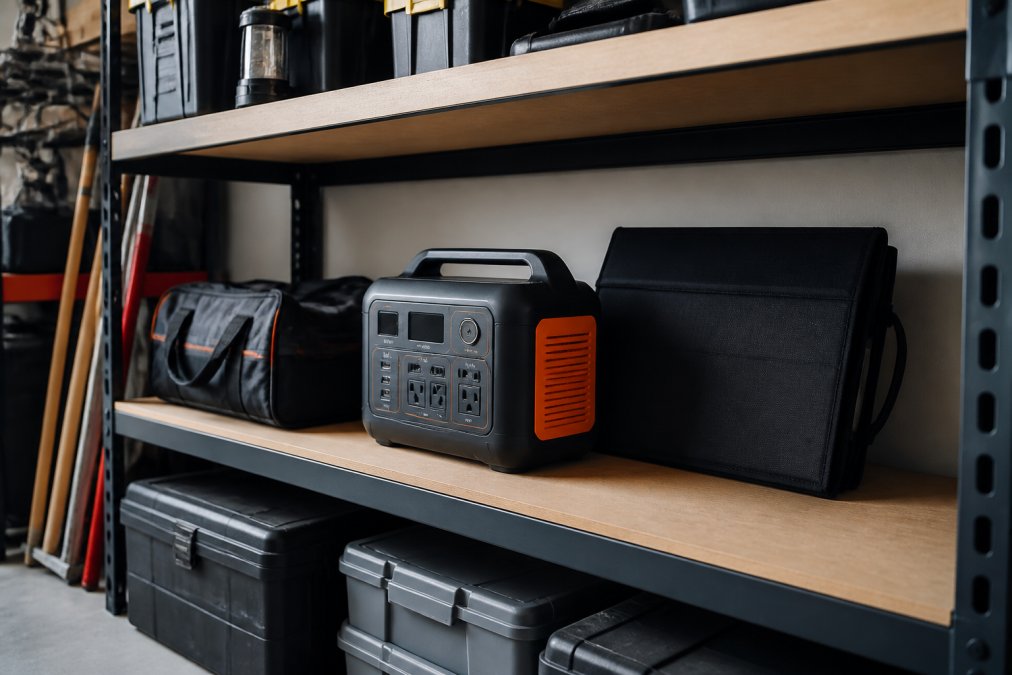
The standard protocol for safe long-term storage:
- Charge to 50-80% before storage. Storing at full charge stresses lithium cells. Storing fully depleted risks deep discharge that can damage the battery management system.
- Store at room temperature. The ideal range is 50-77°F. Avoid unheated garages in winter and hot attics in summer.
- Recharge every 3-6 months. Lithium batteries self-discharge slowly. A unit stored without a top-up charge for 12+ months may drop below the minimum voltage threshold the BMS requires to accept a charge.
- Keep it away from moisture. Humidity accelerates corrosion on terminals and ports.
- Check firmware before relying on it. Manufacturers push BMS and inverter firmware updates that improve performance and safety. Connect to the app and update before storing for the season.
Lithium cells stored at full charge experience greater electrolyte oxidation over time, accelerating capacity loss. Fifty to eighty percent is the storage sweet spot confirmed by battery storage guidance from the National Renewable Energy Laboratory.
Frequently Asked Questions
How many watts do I need for an emergency power station?
Add up the running watts of every appliance you plan to power at the same time. A refrigerator draws roughly 100-400 running watts, a box fan around 50 watts, and phone chargers under 20 watts each. Total those figures, then choose a unit whose continuous AC output exceeds that number. Also check surge watts, a refrigerator compressor can spike to 3-4 times its running draw on startup, so your portable power station must handle that peak power without tripping.
Can a portable power station run a refrigerator during a power outage?
Yes, most units rated at 1000Wh or more can run a standard refrigerator for several hours. A mid-size fridge drawing 150 running watts from a 2000Wh station gives you roughly 10-12 hours before the battery depletes, accounting for inverter efficiency losses. Units like the EcoFlow DELTA Pro (3600Wh) or BLUETTI AC200MAX (2048Wh, expandable) extend that window significantly. Always verify your fridge's surge watt requirement against the station's surge capacity before relying on it.
How long do portable power stations last in storage?
Most lithium-ion units self-discharge at roughly 1-3% per month. LiFePO4 batteries discharge even more slowly. Stored at 50-80% charge in a cool, dry location between 50°F and 77°F, a well-maintained unit should hold usable charge for 3-6 months between top-ups. For long-term storage beyond that, recharge to 50-80% every three months. Storing at full charge or near zero consistently accelerates capacity loss over time.
Are portable power stations safe to use indoors?
Yes. Unlike gas generators, portable power stations produce zero fumes and require no ventilation. They are fully safe for indoor use during power outages. The battery management system in quality units monitors temperature, voltage, and discharge rate to prevent overheating or overload. Units with LiFePO4 chemistry add another layer of safety because that battery chemistry is significantly more thermally stable than standard lithium-ion, making them a reliable choice for enclosed spaces like bedrooms or kitchens.
What is the difference between a portable power station and a gas generator?
A gas generator burns fuel to produce electricity and must be used outdoors due to carbon monoxide risk. A portable power station stores electricity in a battery and operates silently with zero emissions indoors. Gas generators typically offer higher continuous wattage at lower upfront cost, but they require fuel storage, regular maintenance, and produce noise. Portable power stations offer clean energy, silent operation, and pass-through charging via solar panels, making them better suited for residential emergency backup and off-grid power.
Choosing the right portable power station for emergency use comes down to matching capacity and output to your actual appliance load, and then choosing battery chemistry that will still perform years from now. The Modern Merchant Hub's portable energy lineup focuses on exactly this: reliable, functional equipment that works when you need it, without complexity you don't. Subscribe to our emails for new product additions and emergency preparedness guides delivered directly to your inbox.
This article was written using GrandRanker